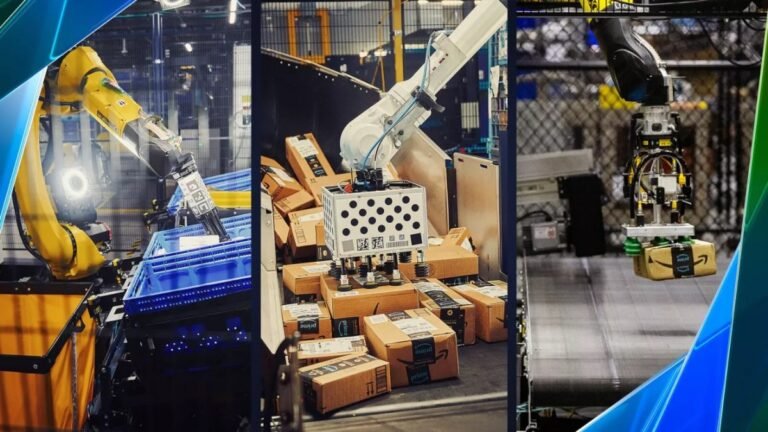
At its Delivering the Future event on Wednesday, Amazon unveiled plans for new robot-powered delivery warehouses. The first “next-generation fulfillment center” is located in Shreveport, Louisiana, covering 3 million square feet across five floors, equivalent to 55 football fields. This marks the culmination of Amazon’s work in robotics, stemming from its 2012 acquisition of Kiva. The company’s new approach aims to integrate robots into workflows without disrupting regular operations.
Amazon has yet to disclose specific figures on the number of robots deployed, but it plans to bring 10 times more robots than a standard fulfillment center. Currently, Amazon has nearly a million robotic systems in operation across the U.S. In addition to Kiva-style autonomous mobile robots and inventory robotic arms, Amazon is introducing Sequoia, a multilevel containerized inventory system designed to speed up and enhance the storage and retrieval of goods.
The hiring of Covariant founders in August suggests a significant role for AI deployment in Amazon’s system. The Louisiana fulfillment center will serve as a crucial test for these robots to work in coordination, a challenge that has been difficult until recently. Amazon emphasizes that human employees will still be involved in the operations at the Louisiana facility, which is expected to employ 2,500 people once fully operational.