Caroline Mitterdorfer began her fertility journey after a cancer diagnosis at age 27. She co-founded Levy Health to help speed Read more

Large corporations typically play it safe when it comes to consumer hardware, sticking to incremental updates year after year. Lenovo, Read more

Welcome to the Edtech World Big news in the education tech world! PowerSchool, the edtech giant, recently experienced a data Read more

Telegram Expanding Access to Crypto Wallet Telegram is now offering its crypto wallet to its 87 million users in the Read more
The product
When you talk to a chatbot like ChatGPT, Claude, or Gemini, your responses are largely linear. You often have to ask follow-up questions to get more information. For instance, when you are planning a trip, you might first ask the chatbot about the place and follow it up with questions on meal planning, activities, tips for the trip, and a packing list.
A team of former Google Maps engineers is building an infinite board interface called Cove. This design should help you generate several responses based on one question or prompt to an AI bot.
The startup founded by Stephen Chau, Andy Szybalski, and Mike Chu has raised $6 million in a seed round from Sequoia Capital, Elad Gil, Homebrew, Adverb, Scott Belsky, Lenny Rachitsky along with other angel investors.
The team has previously worked on some well known Google Maps features like Street View. Both Chau and Szybalski later joined Uber and were part of the team that worked on launching Uber Eats. Jess Lee, who is the lead investor for Sequoia for this round was also a colleague of Cove co-founders at Google Maps.
When they started working on this product, the trio felt that AI could be much more helpful in a collaborative space, especially for tasks like planning, writing, storyboarding, and research. On a call with TechCrunch, Chau said that thinking is a messy process, and you constantly iterate in your head while working on something. Your brain progressively creates branched-out thoughts.
“A lot of inspiration for Cove is really thinking about how we are used to human-to-human collaboration. When we work with other folks, we have a shared space, like a room where there is a shared context, and then we can communicate together on something. That’s what we wanted to build with Cove,” said Chau, expanding on why the startup chose to have an infinite canvas as an interface.
He opined that a chat interface for AI is very linear and not editable. For the most complex projects, having to deal with multiple conversation threads can be cumbersome.
Opportunity and limitations
Cove has an infinite board interface on the web with a chatbot window in the bottom right corner. The bot shows you some suggestions for the projects you can work on through prompts so that you are not just staring at the blank space, thinking about how to get started. These examples include typical prompts like “Help me pick a birthday gift for my mom who likes gardening,” or “Help me plan a week-long trip to Yosemite for a family of four.”
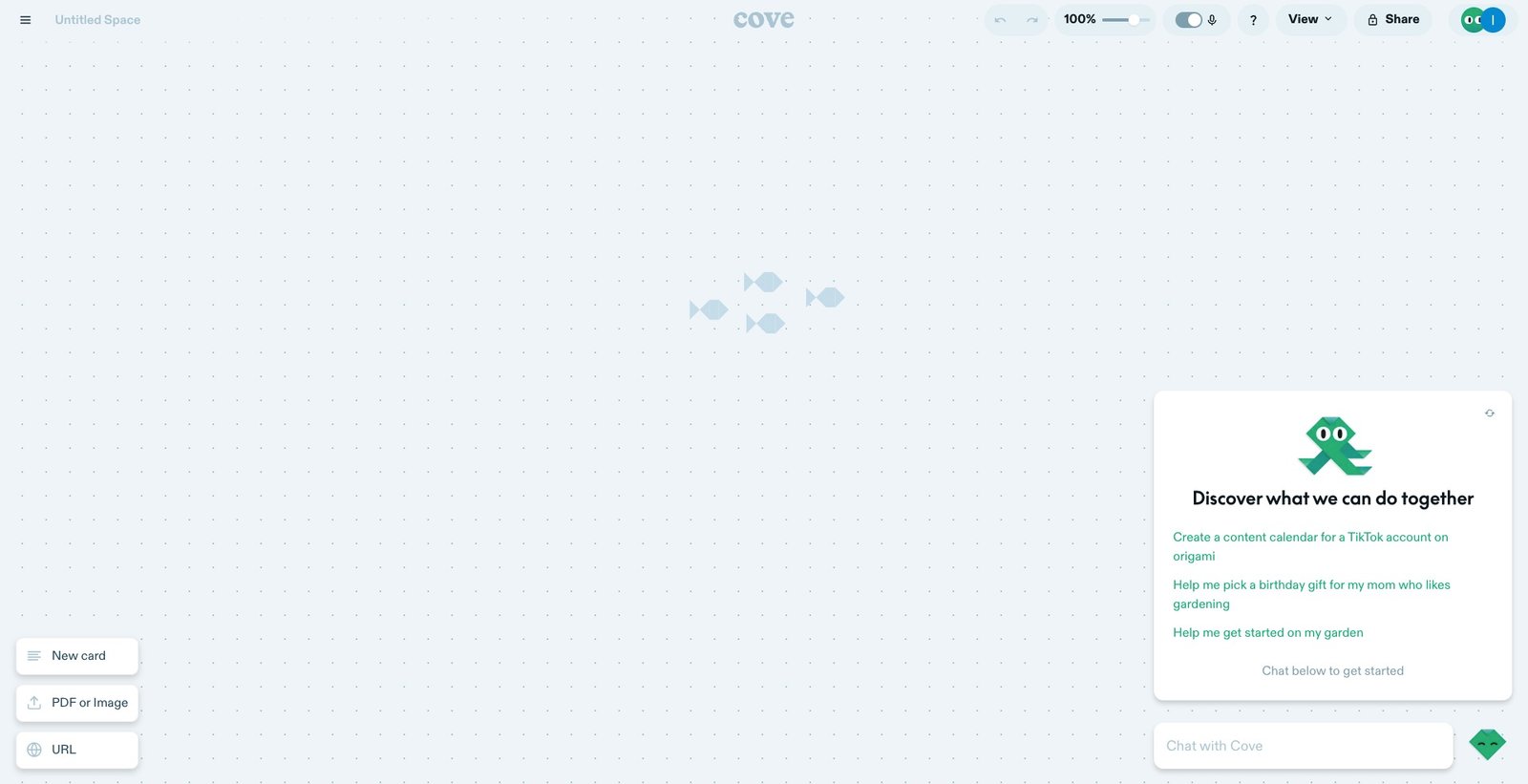
When you click on any of these prompts, Cove will generate multiple response cards with tables and lists related to the prompt. For instance, if you ask the chatbot about trip planning, it can generate cards for meal planning, packing essentials, general tips, a list of hikes, and even create an itinerary.
You can edit any part of these cards by selecting some text and prompting it. You can also create a spin-off card or add more points, lists, or table elements to existing cards.
Users can add PDFs, links through a built-in browser, images, or a new blank card to add more context. They can also ask Cove questions about specific elements by referencing different cards and mentioning them.
Since this is a collaborative board, you can share the link with anyone. Just like in Google Docs, you can share it as a “view only” board or with editing abilities, depending on your needs. When people are collaborating on one board, all of them can invoke AI separately.
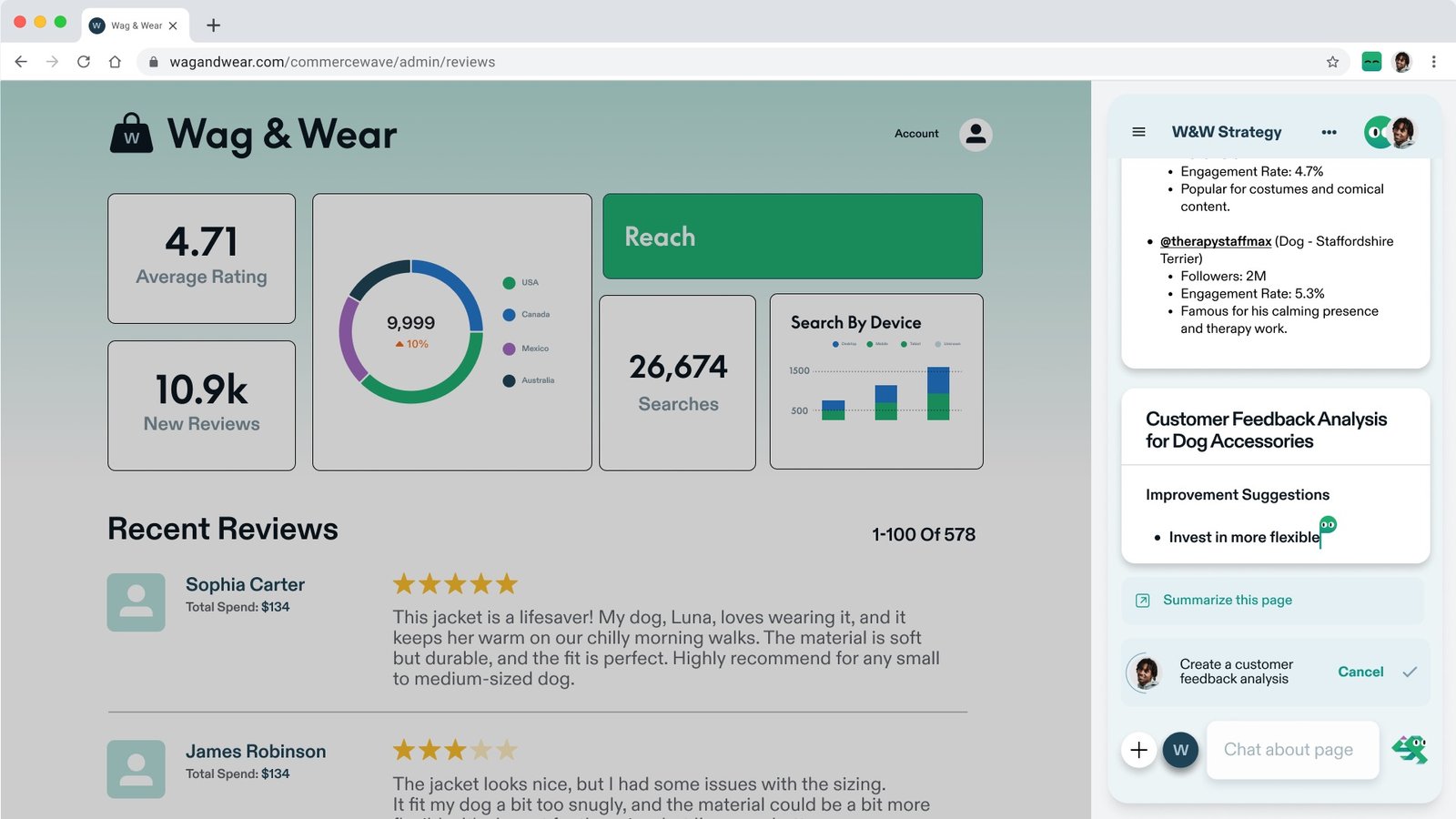
The startup has also released a Chrome extension. When you are browsing a website, you can invoke the extension, ask the AI bot about the site and content on screen, and add that to one of your projects or cards.
“There are products where AI does the work for you and there are products where you do all the work. Cove is designed in a way where AI is more of your thought partner and collaborator. Think of it as an assistant that helps you rather than an oracle that tells you what to do,” said Sequoia’s Lee.
Cove is free to use with a limit of 100 cards. To unlock unlimited cards and get early access to new features, users will have to pay $10 a month.