
Caroline Mitterdorfer began her fertility journey after a cancer diagnosis at age 27. She co-founded Levy Health to help speed Read more

Large corporations typically play it safe when it comes to consumer hardware, sticking to incremental updates year after year. Lenovo, Read more

Welcome to the Edtech World Big news in the education tech world! PowerSchool, the edtech giant, recently experienced a data Read more

Telegram Expanding Access to Crypto Wallet Telegram is now offering its crypto wallet to its 87 million users in the Read more
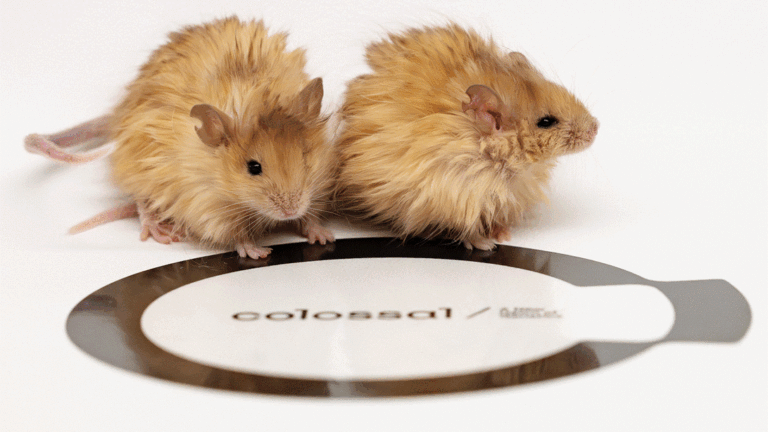
Colossal Biosciences, known for its ambitious plan to bring back the woolly mammoth by 2028, is making progress by genetically engineering mice to have mammoth-like fur. According to Dr. Beth Shapiro, chief science officer at Colossal, the company found mouse versions of mammoth genes and used CRISPR to edit mice embryos, resulting in woolly mice with fur similar to that of a mammoth.
The company believes that the woolly coat will help the engineered mice survive in cold climates, but ethical approval is needed before further experiments can be conducted. Colossal’s approach involves comparing the genome of an extinct woolly mammoth with that of the Asian elephant, its closest living relative.
Despite the excitement over creating the woolly mouse, the ultimate goal of resurrecting the woolly mammoth by 2028 may face technical challenges. Professor David Gold from UC Davis explains that while the creation of a mammoth-like coat in mice is a significant step, there are still many differences between elephant and mammoth DNA to overcome.
Colossal Biosciences is also working on bringing back other extinct species like the Tasmanian tiger and the dodo bird. CEO Ben Lamm considers the successful creation of the woolly mouse a significant milestone for the company’s de-extinction mission, noting the unexpected cuteness of the engineered mice as a bonus.