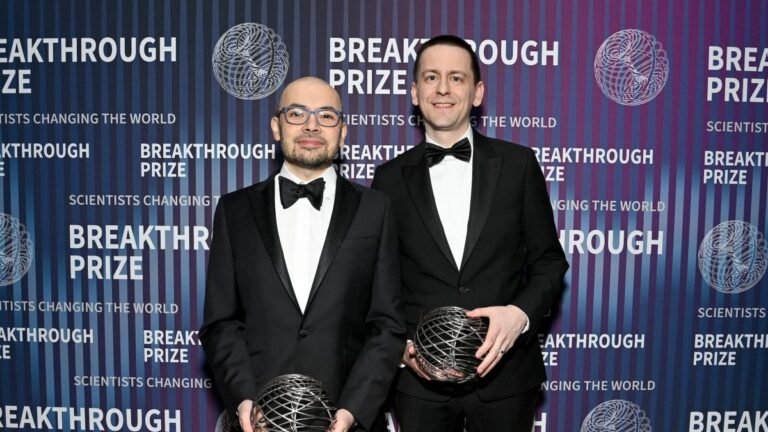
It has been a groundbreaking week for artificial intelligence in the realm of Nobel Prizes. The Royal Swedish Academy of Sciences recently revealed the winners of the 2024 Nobel Prize in Chemistry, with DeepMind’s CEO Demis Hassabis and Director John Jumper sharing half of the prestigious award, while David Baker, the head of the Institute for Protein Design at the University of Washington, secured the other half.
The announcement followed AI pioneers Geoff Hinton and John Hopfield winning the Nobel Prize in Physics the day before for their foundational work in machine learning and AI. Hassabis and Jumper were recognized for their contributions to “protein structure prediction,” while Baker’s accolade focused on “computational protein design.”
Protein Revolution
Proteins serve as the fundamental building blocks of life, making DeepMind’s AlphaFold project revolutionary. With the introduction of the second version of the AI model in 2020, DeepMind made significant strides in predicting the 3D structure of proteins solely based on their genetic sequence, a longstanding challenge for scientists. This breakthrough drastically accelerates the process of determining a protein’s shape, which is crucial for drug discovery, disease diagnosis, and bioengineering.
Heiner Linke, chair of the Nobel Committee for Chemistry, emphasized the groundbreaking nature of these discoveries, referring to them as the realization of “spectacular proteins” and the fulfillment of a 50-year-old dream of predicting protein structures from amino acid sequences. Baker’s contribution involves engineering novel proteins designed computationally to serve specific functions in pharmaceuticals, vaccines, and other applications.
Prodigy Turned AI Innovator
Born in London in 1976, Hassabis showcased early brilliance across various disciplines, achieving master status in chess during his teenage years. His journey led him to become a lead programmer at Bullfrog Productions and eventually earn a first-class honors degree in Computer Science from the University of Cambridge. Co-founding DeepMind with Shane Legg and Mustafa Suleyman, Hassabis saw the company acquired by Google in 2014 for over $500 million, with Jumper joining as a research scientist three years later. Notably, Hassabis was knighted in the U.K. for his contributions to artificial intelligence earlier this year.
Aside from the prestigious recognition that comes with the Nobel Prize in Chemistry, recipients receive a cash prize of 11 million Swedish kronor ($1 million), with Baker receiving half and Hassabis and Jumper splitting the remainder.